


Homemaking can be overwhelming, discouraging, and even isolating.
But it doesn't need to be. Homemaking is not necessarily or inherently discouraging.
We become discouraged and overwhelmed when what we see around us doesn't match up with our expectations or standards.
But before doubling down on doing more or giving up altogether, we need to pause and consider why we feel discouraged. Often, we fall into one (or more) of these three traps: unrealistic expectations, isolation, and burnout.
Trap 1: Unrealistic Expectations
Magazines, social media, and Pinterest paint a picture of homemaking as a perfectly styled, effortless pursuit. But real homemaking isn’t about creating a home that’s always photo-ready—it’s about making a home that nurtures people.
Homemaking is a learned skill, not an innate talent some have and others don’t. It takes time and practice.
When we’re in the thick of doing the real work of homemaking—building up people—there will be messes. Those messes are not failures; they are signs of life, evidence that we’re engaged in meaningful work.
Instead of measuring success by how tidy or stylish our homes look, we need to ask: Are we growing, maturing, and nurturing people in our homes?
If the answer is yes, then we’re doing the work God has given us to do, and the mess is simply part of that process.
Our expectation must be that nurturing people creates messes, but we can clean them up. It's all part of the job and we are more than competent to handle it.
Another expectation mistake is not taking entropy into account. We want getting to the bottom of the laundry pile to last forever rather than one day. We want a menu plan that, once made, makes itself. We want systems that remove us from the picture rather than help us engage with our surroundings.
But we're not setting up dollhouses. We're not engineering machines. We're cultivating life. Our work will always be personal, responsive, and ongoing.
It is possible to derive enjoyment from the ongoing nature of our work, but first we have to stop fighting it.
Read more: Entropy: Why housework feels pointless
Trap 2: Isolation
In a world where connection is just a click away, we still feel alone in our homemaking struggles.
That’s because most people only share a curated version of their lives, and we begin to think we’re the only ones struggling. We compare our everyday reality to someone else’s best (probably filtered) moments and feel like failures.
Historically, homemakers weren’t isolated. Women worked together—at quilting bees, laundry day at the river, or simply in each other’s homes, working side by side at their labor-intensive tasks.
They saw one another’s messes and struggles, and they shared real-life wisdom.
We need to step away from curated images and into real-life relationships. If you feel alone in your homemaking, invite someone over. Start a conversation with another mom at church.
One invitation won’t fix everything, but it’s a step toward fostering true community and setting realistic expectations.
Read more: How to practice everyday hospitality (even when it's awkward)
Trap 3: Burnout
When we feel burnt out, the world tells us to do less—to cut back until we no longer feel overwhelmed.
Eliminating as much work and obligation as possible is giving in to the burnout. Cutting back too much leads not to peace but to apathy, the modern homemaker's greatest enemy.
And as homemakers, we don’t have the luxury of opting out—our families rely on us for the basics of daily life.
The real answer to burnout isn’t doing less; it’s knowing why we’re doing the work in the first place.
The solution to burnout is repenting of apathy and discontent. Apathy must be replaced with a deep understanding of the worth and value of the work we do at home.
Homemaking isn’t meaningless drudgery—it’s kingdom work.
We are growing, feeding, and nurturing people. When we step back and see the bigger picture, we can approach the work with joy, rather than resentment.
Try the Beat Burnout Bingo Challenge
Small wins, stacked up and noticed, will beat your burnout.
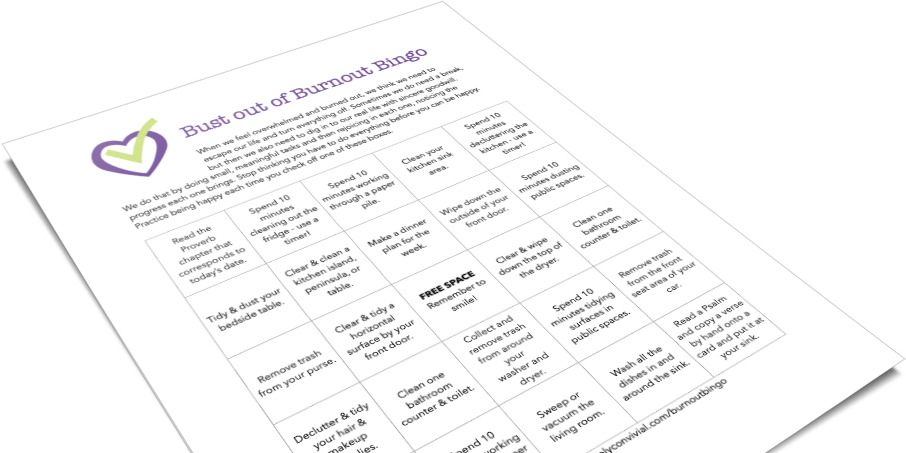
Stop drifting and swirling at the whim of your emotions. Using this game format and noticing the progress you can make in 5 and 10 minutes will renew your attitude about yourself and your home.