


The adolescent years are where we are most tempted to give up homeschooling, yet home can be such a needed supportive atmosphere for the turbulent pre-teen years. The curriculum is not the most important piece, but it is where we often begin.
Let me share the curriculum we’ve used to homeschool middle school, as well as some sanity and survival tips along the way.
Middle school can be a rough time for kids and for parents, but if we set our expectations in line with reality and commit to parenting as well as teaching through thick and thin we can all experience the joy that comes with perseverance.
Seventh & Eighth Grade Homeschool Life
As homeschooling moms, we have the ability (and necessity!) to plan not just academics, but the whole big picture for our children, taking their individual needs into account and adjusting based on all of life and not just school checklists.
So, thinking holistically, school is not just about the books and the work, but about helping the student grow and mature.
A 12-year-old student will do what he can to get autonomy and it won’t make sense to mom. It will look different for different personality types – some are more openly argumentative while others prefer subversion – but often it feels like a 12yo (or 11, or 13 – different kids hit it at different times) is a large 2yo.
However, as mothers with a monthly reminder of how hormones mess with perspective and emotions, we’ve got to take it in stride and realize it’s a season to walk with them through, not a time to despair because we thought they knew better.
So my personal priority with my seventh grader is independence with accountability.
Where possible, he can exercise freedom and independence in his work: where it’s done, when it’s done, what order it’s done in. But, there’s also structure I need to maintain to keep him accountable: work before play, work done by the end of the week, and work always looked at weekly.
If the accountability slides, so will the work – that’s not because I’ve failed to install a work ethic, but because he’s human. It’s also because he’s ripe for learning some lessons through experience about getting work done – so my priority as teacher-mother is making sure he sees natural consequences – both of getting work done early and of getting work done late, of getting work done well and of getting work done sloppily.
Rather than expect I can set things up so he has zero work ethic issues, I’m going into it knowing that experiencing consequences is a large part of his current life curriculum.
When planning eighth grade, perhaps more than any other grade, you have to consider what your plans are for the following years. Will you choose a day school high school? Then your year must focus on ensuring they’ll be ready for tests, specific studies, and homework.
Will you homeschool high school? Then your year should include training for independent study, writing instruction, and making sure you’re ready for whatever extra requirements your state might have for tracking and crediting work.
Middle School Scope and Sequence
For sixth grade, or around 11-years-old, we just continue with whatever we were doing in elementary without any major changes in expectations or assignments. Fifth or sixth grade or both are the years we do grammar and beginning writing.
In 7th grade, students begin to commonplace, start a Book of Centuries, receive new art and school supplies, and have class homework for which they are responsible. Our 7th grade year includes ancient history and literature, history of scientific discoveries, Art of Argument, Grammar of Poetry, Bible Survey (2-year program), language (Latin or choice), written & drawn narrations, and nature study. They also continue making progress in Math-U-See, based on mastery, as well as progress in piano.
8th grade is a continuation, with the added responsibility of managing some work as weekly tasks so they have opportunity to practice (which means learning through experience & failure) time and task management. In 8th grade, the plan includes medieval history and literature, Bible Survey, chemistry or earth science, Introductory Logic, language (Latin or choice), essay writing & written narrations, and nature study. They also continue making progress in Math-U-See and piano.
Curriculum We've Used in Middle School
Math & Logic
We've always simply continued with Math-U-See. In middle school I expect my students to get at least through Algebra 1. Sometimes we supplement with Khan Academy lessons on particular topics, and we've also supplemented with Learn Math Fast books as needed.
For Logic we've used Art of Argument together in our casual mini co-op. When the student is doing decently in Algebra, we begin formal logic using Canon Press' Introductory Logic and Intermediate Logic.
Bible & Theology
Of course Morning Time is a large part of our Bible program. That is where we get to know, love, and meditate on Scripture itself, worship through song and prayer, and learn doctrine through catechism.
However, we also always do some other additional learning of Scripture and doctrine in our studies.
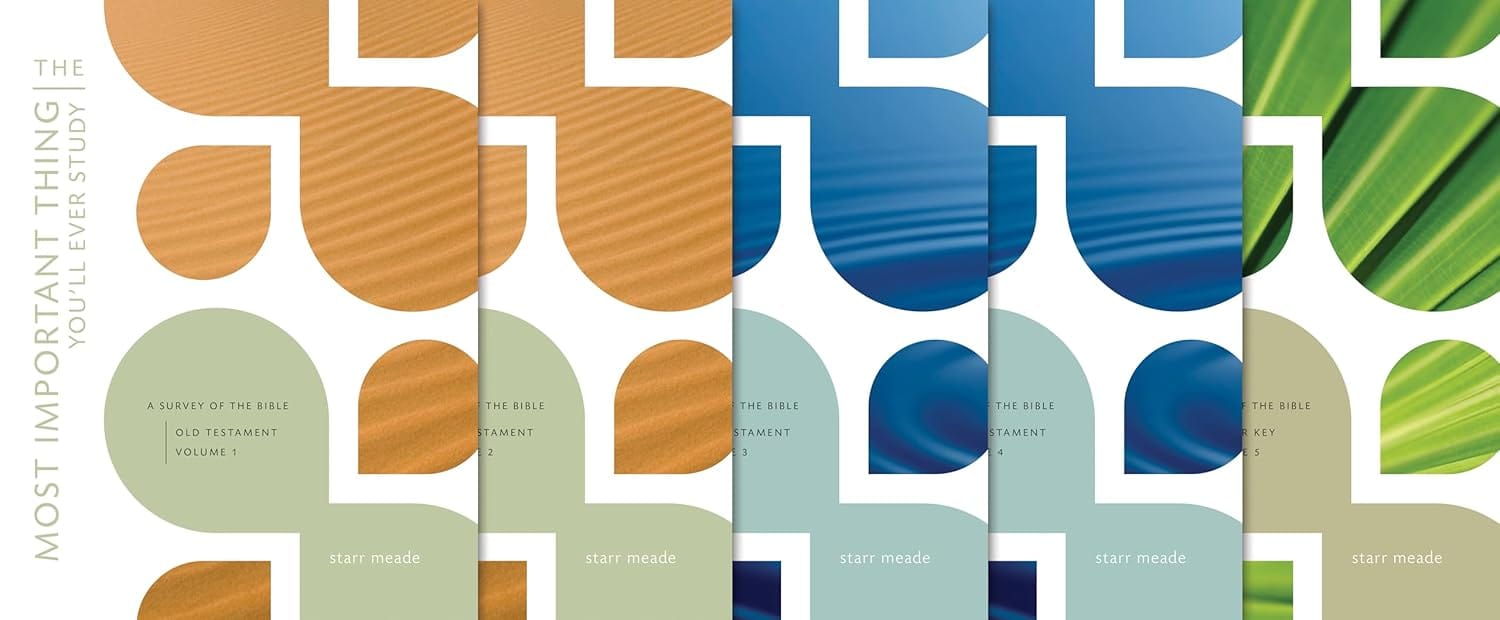
In fifth and sixth grade, I assign the workbook-based Most Important Thing You'll Ever Study by Starr Meade. It's never been a favorite with my students because it's the first fill-in-the-blank work they've done, but it is sound and I think it's important to go through the whole Bible and get the background and basics before going into theology reading in the teen years. The four volume set includes background and summary information through the Bible, assignments for reading through the Bible, and short answer questions to complete after the readings.
In 7th grade, I assign a "Basic Christianity" set of books as my student transitions into normal adult books as the basis for study.
- Basic Christian Living, Doug Wilson - one final fill-in-the-blank workbook; I don't care about the blanks so much as reading the lessons and talking about them together.
- Basic Christianity, John Stott
- Being Christian, Jim Wilson
- Knowing God, J.I. Packer
History
In seventh grade we restart a 3 year history cycle to get an overview before high school. The Ancient Mediterranean by Michael Grant is our spine for ancient history. It covers early civilizations like the Philistines and Minoans and goes through the Roman Republic. It’s not a very large book, either, so we only need to read about 1/3 of a chapter a week. It’s for an adult layman, so it’s not trying to be appealing or interesting or funny to a middle school boy, which I think is a plus.
Additional reading for seventh grade history depends on what each student has already read, what kind of a reader they are, and what the rest of their school year looks like. It's been different for each one.
Eighth grade is then a medieval history year and Winston Churchill’s Birth of Britain is our spine for that. However, there is more to the Medieval world than Britain, so to develop a bigger sense of the period, we’re also using these titles as supplemental reading, spread out over the year:
- Shortest History of Europe by John Hirst
- How the Irish Saved Civilization by Thomas Cahill
- God’s Battalions: A Case for the Crusade by Rodney Stark
- Here I Stand by Roland Bainton
Science
For sixth and seventh grade, each student has done something slightly differently, depending on where we're at in Elementary Lessons. I really want a good history of science overview this year and have used a couple different books to attempt to get it, but nothing I liked or would recommend. For my youngest, I stopped trying.
Eighth grade science for us is Novare's Earth Science. It covers several different topics in one book: basic astronomy, weather, water cycle, volcanoes, geology – it’s all related to earth, yet it has varied topics. It is an old-earth creationist perspective, which we talk about as interesting to learn that perspective without taking the textbook as an infallible source of absolute truth. I think it's helpful not only to understand the old-earth position, but also to receive as the first textbook we've used, one that we know from the get-go isn't completely true. We're reading a person's perspective and interpretation, just as with any other book.
The assignment – twice weekly – is to read a section and add an entry into a science journal. The entry must contain a drawn chart or illustration (which can be copied from the book) and also words needed to explain the drawing. He has enjoyed this structure for working through the book.
Literature
We’ll read Beowulf, Sir Gawain & the Green Knight, a paraphrasing of Canterbury Tales, and Fierce Wars & Faithful Loves (a paraphrase of The Faerie Queene). This will be mostly the same group I had last year for logic & poetry & grammar, so I’ll also add in some medieval poetry between books and we’ll diagram together on the board to keep up our skills.
I’ll have the kids keep a commonplace journal, but my goal is to make the atmosphere of the class like a book club. Instead of lecturing, I’ll be leading book discussion and getting them to voice opinions – and then back those opinions up with evidence from the text. It’ll be fun. Middle school kids are great for this sort of thing.