


A commonplace journal is not complicated and doesn’t need to be fancy. It is simply a place where notes and quotes from our reading are kept.
The simpler we keep it, the better. Let me show you how basic commonplacing really can be.
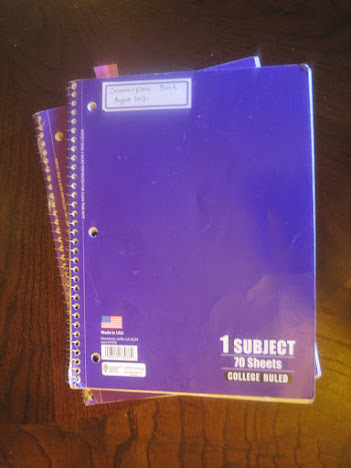
It appears I am the cheapskate of the group. I use college-ruled spiral notebooks that are about a dime each in August. I stock up on purple ones for me each year and other colors for the kids to use. Using a cheap notebook was the secret to overcoming paralyzing perfectionism.
When my journal was pretty, I didn’t want to write in it unless I was using my very best handwriting and copying down only the very best and most impressive quotes – it felt like creating a keepsake. And, in practice, that meant that I never used it, because, as C.S. Lewis has noted, “favorable conditions never come.” The right pen was never at hand, I was too tired, I was reading on the couch and couldn’t really make it my best handwriting.
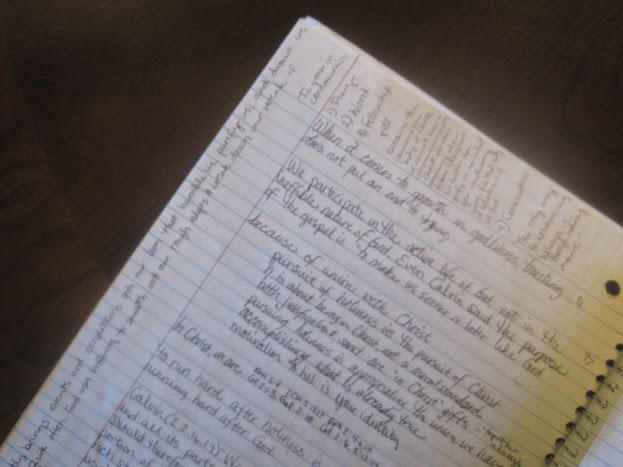
~from Hole in Our Holiness by Kevin DeYoung~
With a cheap notebook, it is more about the process than the product. It is about the act of copying, of jotting down ideas so I can think them through more clearly. I can turn the page any which way, organize quotes for one book differently from notes for another book, and it doesn’t bother me like it did when I was trying to keep a pretty notebook.
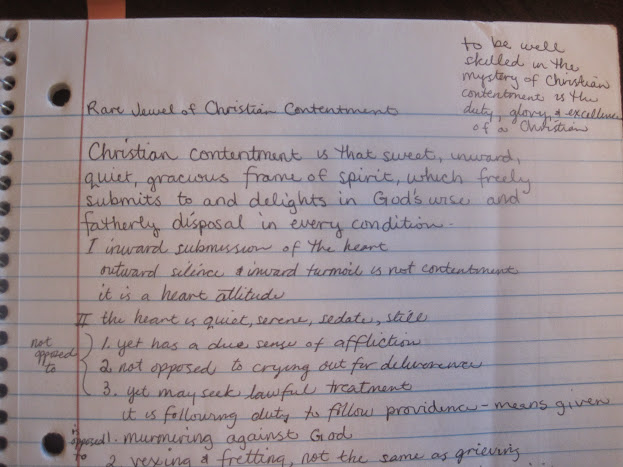
~from The Rare Jewel of Christian Contentment by Jeremiah Burroughs~
So scaling back the expectations has freed me from self-imposed pressure to perform and shifted the focus to where it should be: interacting with the authors and ideas I am reading.
Here’s what I use:
- Cheap spiral-bound college-ruled notebooks
- Retractable RSVP ballpoint pens (I like the way these feel and write, and I prefer ballpoint to marker-type or gel pens)
- Pentel Twist-Erase mechanical pencil if I’m also jotting in the margins of the book (I don’t if it’s a book I think someone else will read)
- Post-it flags to note the page of my commonplace section for my current book.
- Book holder for propping up my book while I’m copying, because holding a book open and writing at the same time is sometimes tricky.
Rather than having a running list of quotes I write as I read them, I keep a section for each book. I put the title up at the top and make sure to leave 5-8 sheets free before I start the section for another book. Because the notebook is cheap, I don’t mind if I waste some space here and there.
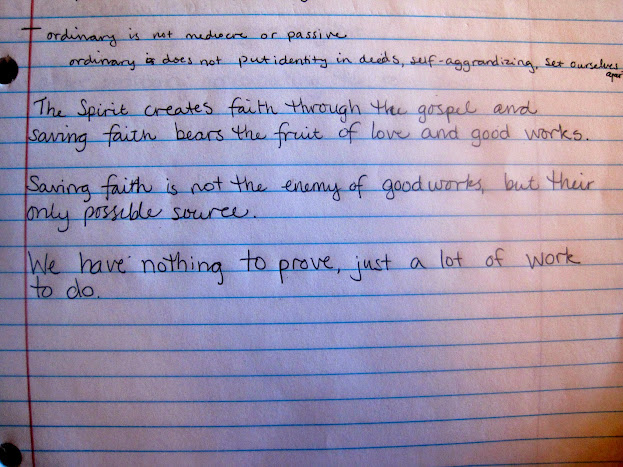
~from Ordinary: Sustainable Faith in a Radical and Restless World by Michael Horton~
When I’m done with a book (or, more like 2 times a year) I’ll scan and save the notes into Evernote rather than save the notebook, which is usually a beat up, marked up, used up thing when I’m done with it – not something worth saving for posterity. But that’s ok.
The process of copying down quotes and jotting down notes was the primary point – encouraging deep reading and thinking as I went along. If I can then find quotes or thoughts afterwards, that’s a bonus. And it’s more likely to happen if that information is saved digitally.
Because Evernote does OCR, a search pulls up words I search for, even if those words are in my scanned handwriting. It can be very fascinating to search for a word like “teaching” in my Evernote commonplace notebook and see all the quotes I wrote with that word from a myriad of sometimes quite unrelated sources. The connections that can be made this way make it worth the effort.
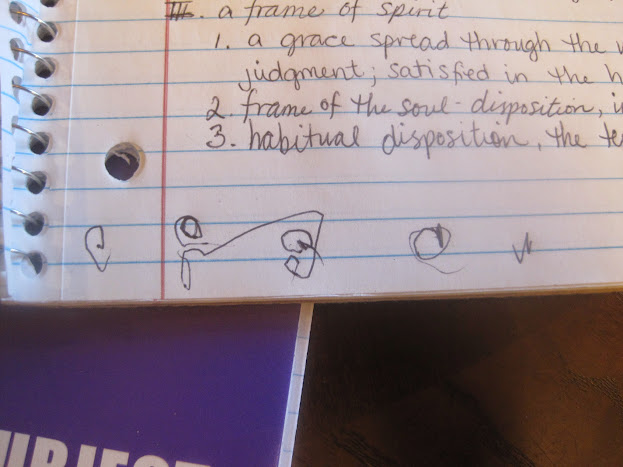
~from The Rare Jewel of Christian Contentment by Jeremiah Burroughs~
Another reason the cheap notebook is a good option for me is that I’m not always the only one who writes in it. Sigh.
So, when I start a new book, I try to follow this process, but I don’t stress about doing it “right” because then I’d never start:
- Write the title and author at the top, along with the month and year I began reading
- Copy out the table of contents in an outline form – supposedly to make a short summary of each chapter as I go, but most of my book notes only have a summary for the first two chapters.
- Quotes I like as I go. I also always try to copy out the sentence that sounds like the best thesis statement and put a star next to it.
- My own notes in the margins or written out with an arrow pointing at them or on a separate page.
- A running bibliographic trail, as George Grant calls it, of books the author mentions along the way
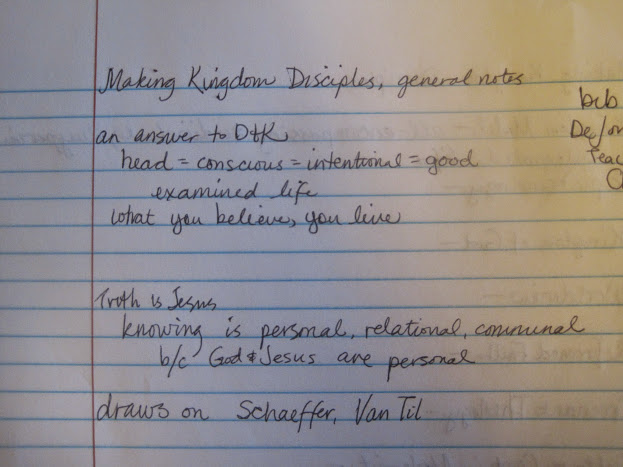
~from Making Kingdom Disciples by Charles Dunahoo~
After finishing Consider This late one evening and not having a fullness of head and heart and no one to talk to, I turned the page in my commonplace journal and wrote out a paragraph “reader response” that felt like a spilling out of my mind onto the paper.
I suppose it was sort of like a written narration with some added commentary, and ever since then I’ve also wanted to do that with each book I’ve finished, but I haven’t made it a habit yet.
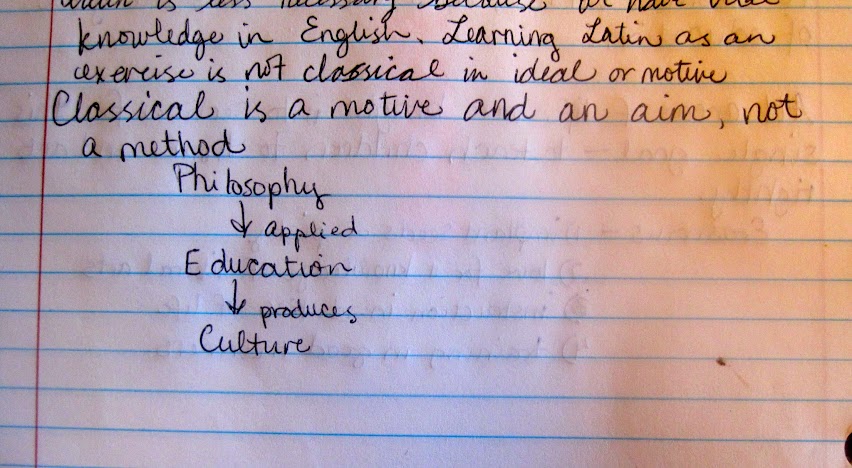
~from Consider This: Charlotte Mason and the Classical Tradition by Karen Glass~
The bottom line is that my commonplace journal is a place for me to become a keeper, to become a more thorough thinker, to allow the ideas I encounter to seep in more deeply.
Whatever practices you can find along the way that encourage you to continue that process rather than achieve some ideal end product are the practices you should cultivate.